

Alyssa’s Law is reshaping how public schools across America prepare for and respond to life-threatening emergencies. As of 2026, more than a dozen states have enacted it, dozens more have legislation in progress, and a federal version is under consideration in Congress. For school district leaders, understanding Alyssa’s Law is no longer optional in a growing number of states; compliance is the law.
This comprehensive guide answers every question district administrators, superintendents, and safety officers have about Alyssa’s Law: what it requires, which states have passed it, what compliance actually entails, how to fund it, and how to select a system that meets the mandate without failing when it matters most.
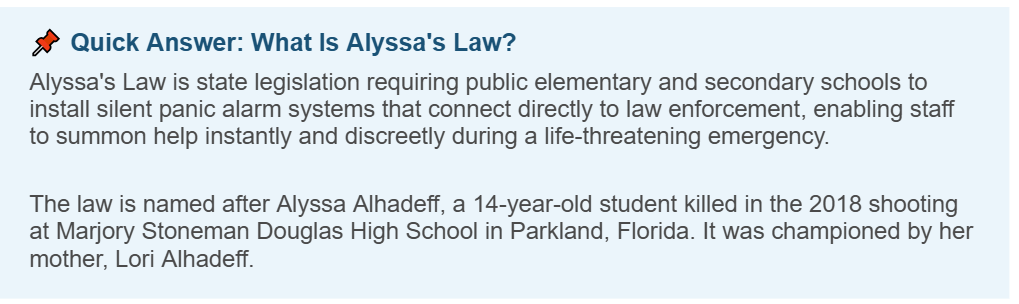
What Is Alyssa’s Law? The Origin and Purpose
On February 14, 2018, 14-year-old Alyssa Alhadeff was one of seventeen people killed in the mass shooting at Marjory Stoneman Douglas High School in Parkland, Florida. In the aftermath, her mother, Lori Alhadeff, became a national advocate for school safety reform and the driving force behind the legislation that now bears her daughter’s name.
The core insight behind Alyssa’s Law is simple but powerful: in a life-threatening emergency, the minutes it takes to reach a phone, dial 911, explain the situation, and wait for dispatch are minutes that cost lives. Alyssa’s Law closes that gap by requiring schools to install silent panic alarms that notify law enforcement directly and instantly with a single action, no phone call required.
The goal of Alyssa’s Law: reduce law enforcement response time during school emergencies by creating a direct, silent link between school staff and first responders.
Alyssa’s Law Requirements: What Compliance Actually Means
While the exact wording varies from state to state, most versions of Alyssa’s Law share a consistent set of core requirements. Understanding these is essential because a system that meets some requirements but not others does NOT achieve compliance.
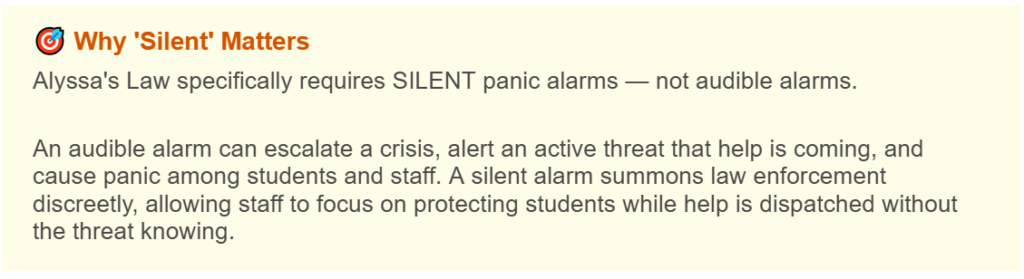
- Silent panic alarms. The system must be silent inside the school, not an audible alarm that could escalate the situation or alert a threat.
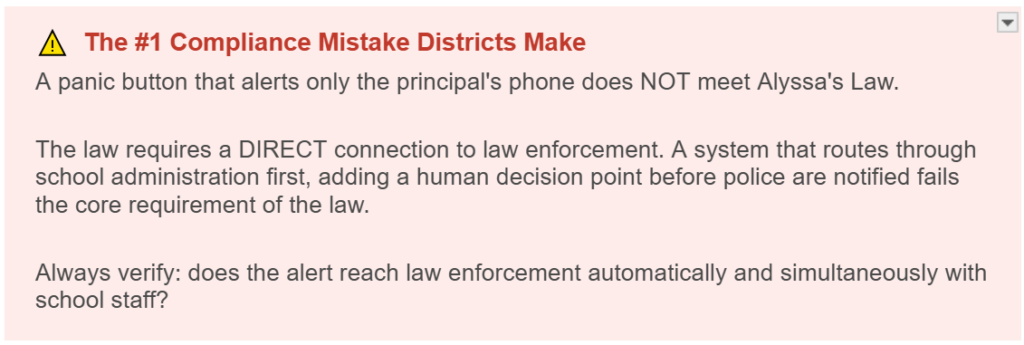
- Direct law enforcement connection. The alarm must connect directly to local law enforcement or a public safety answering point (PSAP), not just to school administration. This is the requirement most misunderstood.
- Staff-initiated activation. Any staff member must be able to activate the alarm quickly and easily from anywhere on campus.
- Accessibility throughout campus. The system must be accessible to staff throughout the entire campus, not just in the main office or at fixed points.
- Location data to responders. Advanced compliance requires the system to transmit precise, room-level location data to first responders, so they know exactly where the emergency is.
- Real-time multi-agency coordination. The system should enable real-time coordination among multiple first responder agencies — county, local, and on-site.
- Integration with existing systems. Many states require the system to integrate with existing school safety plans and security infrastructure.
Which States Have Alyssa’s Law? Current 2026 List
Alyssa’s Law began in New Jersey in 2019. In the years since, it has spread rapidly across the country. Here are the states that have ENACTED Alyssa’s Law as of 2026:
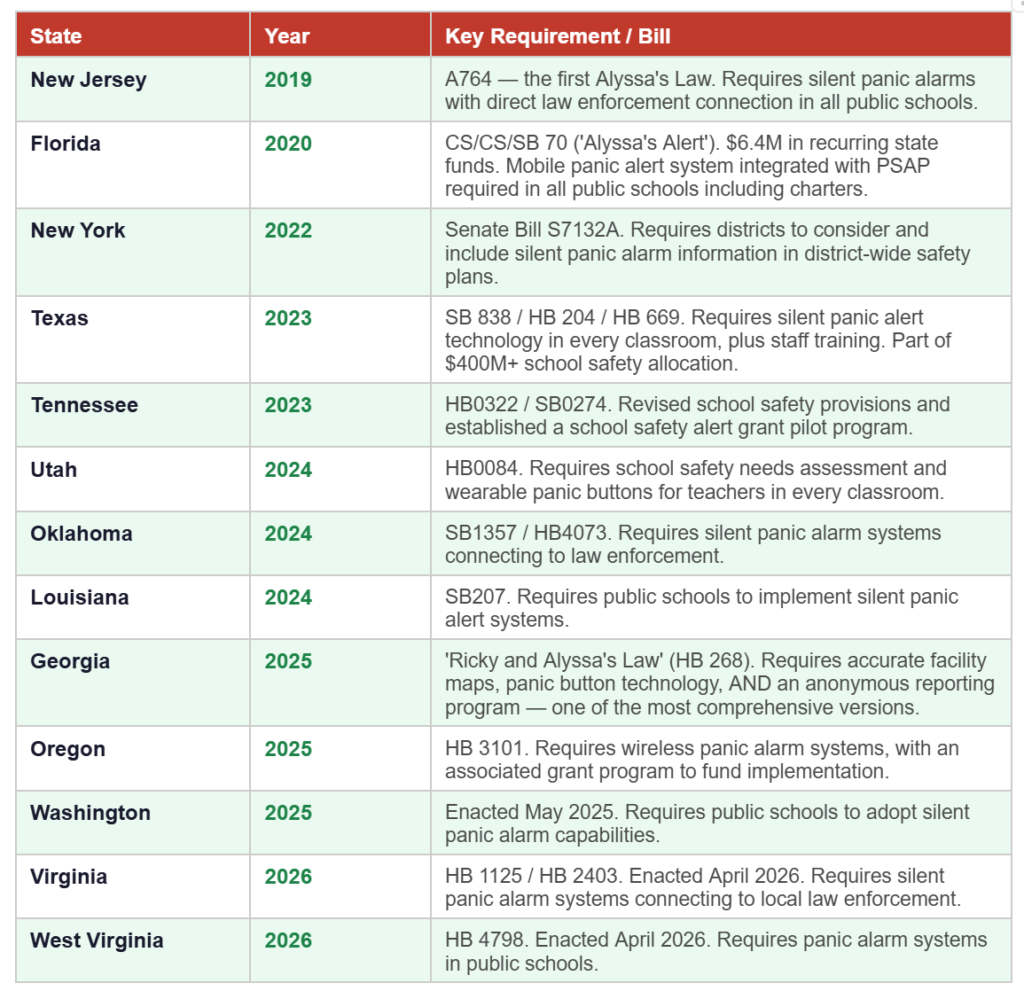
In addition to the states that have enacted the law, many more have legislation actively in progress in 2026.
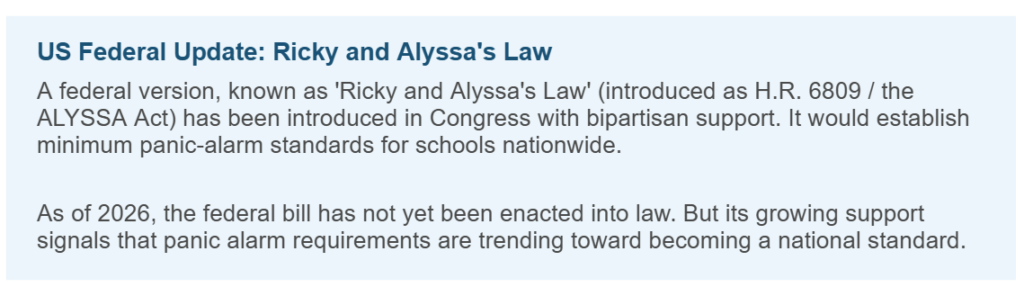
Note: Alyssa’s Law requirements and enactment dates change frequently as new states pass legislation. Always verify your state’s current specific requirements with your state education agency before making compliance decisions.
How Districts Comply With Alyssa’s Law: A Step-by-Step Path
Achieving Alyssa’s Law compliance is a process, not a purchase. Here is the path well-prepared districts follow:
- Confirm your state’s specific requirements. Requirements vary significantly. Some states require systems in every classroom, others require campus-wide staff access. Contact your state education agency for the exact statutory language.
- Conduct a school safety needs assessment. Many states legally require this as part of compliance. Assess your current communication systems, identify coverage gaps, and document vulnerabilities.
- Evaluate systems against the full requirement set. Use the compliance checklist below. A system must meet every core requirement: silent operation, direct law enforcement connection, campus-wide staff access, and location data.
- Verify network reliability. The alert is worthless if the network carrying it fails during a crisis. Confirm the system operates independently of WiFi, which congest or fail during emergencies.
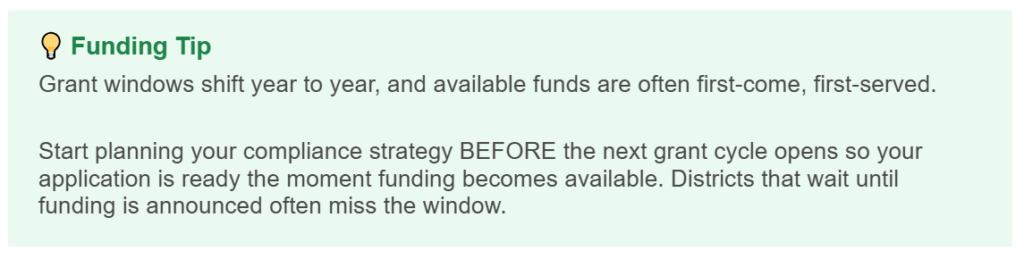
- Secure funding. Federal and state grants exist specifically for this purpose (see funding section below). Start the application process early as grant windows shift year by year.
- Deploy and integrate. Install hardware campus-wide, configure the direct law enforcement notification, and test the connection to your local police department.
- Train all staff annually. Most state laws require documented annual staff training on the panic alarm system and emergency protocols.
- Document everything for compliance reporting. States require ongoing compliance documentation. Keep records of installation, testing, training, and any system changes.
How to Fund Alyssa’s Law Compliance
One of the biggest barriers districts cite is budget. The good news: significant funding exists specifically for school safety technology, and much of it can be applied directly to Alyssa’s Law compliance.
Federal Funding Sources
- COPS School Violence Prevention Program (SVPP): Historically provides up to $500K per award at 75% cost coverage, with tens of millions authorized annually. Monitor https://cops.usdoj.gov/ for application windows.
- STOP School Violence Grant Program (Bureau of Justice Assistance): Funds training, technology safety solutions, and school safety strategies.
State Funding Sources
- State-specific allocations: Florida allocated $6.4M in recurring funds; Texas allocated over $400M for school safety; Oregon offers per-school reimbursement grants.
- State school safety grant programs: Many states that pass Alyssa’s Law simultaneously create dedicated grant programs to help districts fund compliance.
🔗 Related Reading on the SimulAlert® Blog
School Safety Grants Guide: Funding Your Emergency Alert System
Panic Button in Schools: The Complete 2026 Guide
Safety Plan for Students: The Complete 2026 School Guide
What Is a Code Red Lockdown in Schools? Protocols & Preparedness
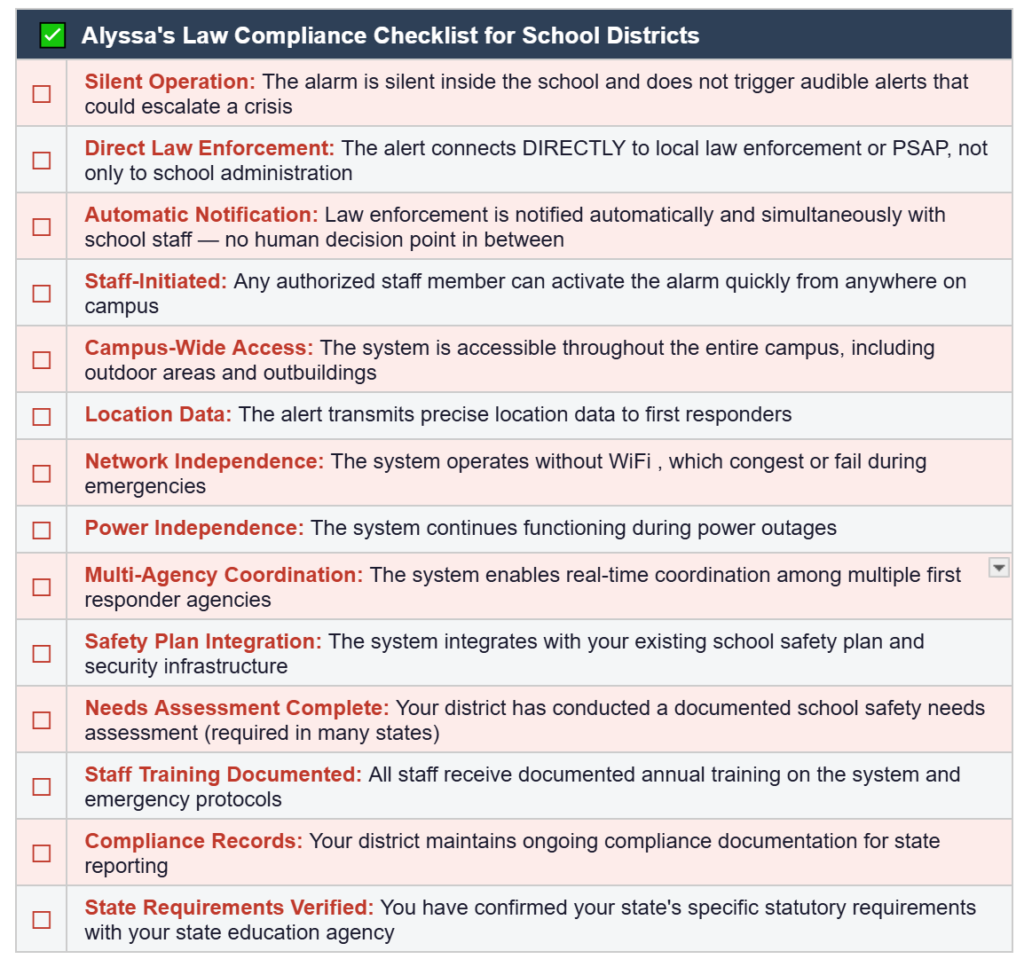
Alyssa’s Law Compliance Checklist for School Districts
Run any candidate system and your overall compliance readiness through this checklist:
How SimulAlert Helps Districts Meet Alyssa’s Law
SimulAlert was purpose-built for the exact requirements Alyssa’s Law establishes. Every core requirement of the law maps directly to a feature SimulAlert was designed to deliver.
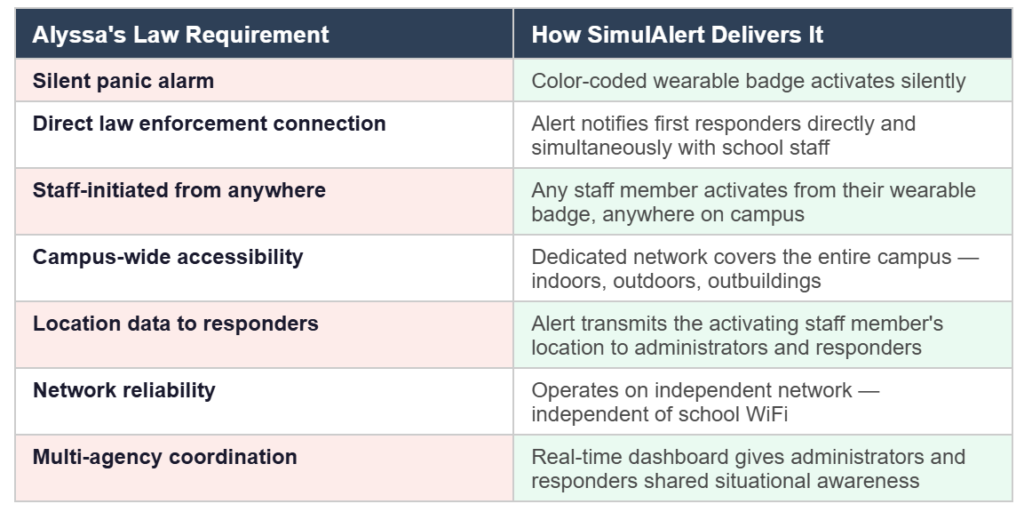
Where many systems fail Alyssa’s Law is on network reliability. App-based and WiFi-dependent systems can go down during the exact congestion that accompany real emergencies. SimulAlert’s was designed specifically to remain operational when everything else fails, meeting not just the letter of Alyssa’s Law, but its life-saving intent.
Conclusion: Alyssa’s Law Is Coming to Every State — Prepare Now
Alyssa’s Law began in a single state in 2019. Over six years later, more than a dozen states have enacted it, dozens more are moving toward it, and a federal version is gaining momentum in Congress. The direction is unmistakable: silent panic alarms connected directly to law enforcement are becoming the national standard for school safety.
For district leaders, the question is no longer whether to prepare for Alyssa’s Law, it is whether to prepare proactively, on your own timeline and budget, or reactively, under a compliance deadline with limited funding options. Districts that plan now, assess their gaps, and secure funding early will be ready. Those that wait will be scrambling.
Alyssa’s Law exists because of an unimaginable tragedy. Honoring its purpose means more than checking a compliance box, it means giving every staff member on your campus the fastest possible way to summon help when a life is on the line.
🚀 Ready to Prepare for Alyssa’s Law Compliance?
Request a Free
Demo