Every school has a safety plan. But most safety plans sit in a binder on an administrator’s shelf, reviewed once a year, seldom tested, and often forgotten by the people who would actually need to use it in an emergency.
A truly effective safety plan for students is not a document — it is a living system that every staff member understands, every classroom reflects, and every parent trusts. This complete guide covers exactly what a student safety plan must include, how to create one step by step, and what technology separates schools that respond in seconds from those that respond in minutes.
What Is a Student Safety Plan?
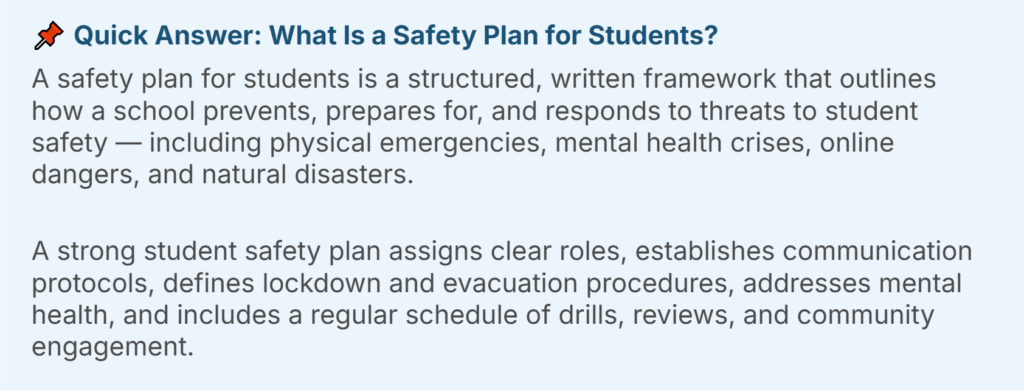
A student safety plan is a formalized set of policies, procedures, and protocols designed to protect students from harm across all dimensions of school life — from physical threats on campus to cyberbullying online, from medical emergencies in the classroom to mental health crises in the hallway.
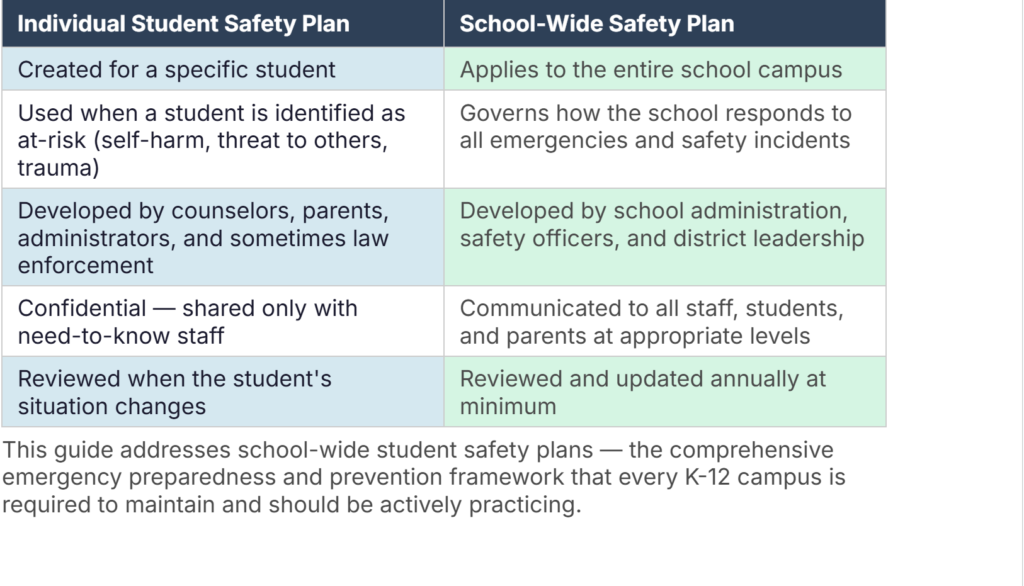
The term covers two distinct but related concepts that schools often confuse:
Why Every School Needs a Student Safety Plan — And Why Most Fall Short
Federal law (the Every Student Succeeds Act) and most state laws require schools to maintain a written safety plan. But legal compliance and actual preparedness are not the same thing. Most school safety plans fail for one of the following reasons:
- The plan is written but seldom practiced: Staff have never walked through the procedures. When an emergency happens, nobody can find the binder and nobody remembers what it says.
- Communication systems are untested: The PA system, phone tree, or alert app listed in the plan has never been tested under actual stress conditions — network overload, power failure, or outdoor coverage gaps.
- The plan assigns roles without training: The plan says ‘the principal initiates lockdown’ – but what happens when the principal is off campus? No backup procedure is documented or practiced.
- It covers too much and prepares for nothing specifically: Generic safety plans try to address every possible scenario in the same vague language. Real preparedness requires scenario-specific procedures that staff can execute without thinking.
- It is never updated: Staff turnover, building renovations, new students with medical needs, and changes in local law enforcement procedures make last year’s plan dangerously outdated.
📊 The Stakes Are Real The U.S. Government Accountability Office (GAO) found that the majority of school districts have not conducted a comprehensive safety assessment in recent years — and many safety plans in use contain outdated contact information, superseded procedures, and missing protocols for emerging threat types. A safety plan that is not regularly practiced, updated, and tested is not a safety plan — it is a liability. |
The 6 Core Components of an Effective Safety Plan for Students
A comprehensive safety plan for students must address six distinct domains. Weakness in any one of them creates a gap that a real emergency will exploit.
 Physical security is the first line of defense in any student safety plan. It determines who can enter the campus, how threats are detected before they reach students, and how the building itself limits the spread of danger during an active incident.
- Controlled entry points: All visitors must enter through a single, monitored access point with ID verification before reaching any student area.
- Door hardware: Every classroom door must be lockable from the inside without a key — a deceptively rare feature in older school buildings.
- Camera coverage: Surveillance cameras should cover all entry points, parking areas, hallways, and common spaces with real-time monitoring capability.
- Perimeter management: Fencing, signage, and landscaping that maintains clear sightlines around the building — eliminate visual blind spots that obscure approaching threats.
- Visitor management system: A digital system that cross-references visitor IDs against sex offender registries and custody orders before issuing a visitor badge.

The fastest, most well-designed lockdown procedure is worthless if staff cannot receive the alert. Your emergency communication system is the backbone of your entire safety plan — and it is the most commonly underestimated component.
An effective school emergency alert system must:
- Reach every person on campus simultaneously: Including outdoor staff, staff in outbuildings, and staff on planning periods away from their classrooms — not just those near a PA speaker.
- Work without WiFi, cellular, or building power: The very conditions that accompany real emergencies — power outages, network congestion, downed infrastructure — are exactly when most alert systems fail.
- Allow any authorized staff member to initiate an alert: Not just the principal. A threat is most often first observed by a teacher, custodian, or cafeteria worker.
- Provide real-time accountability: Administrators need to know instantly which rooms have locked down and which have not responded — without calling each one individually.
- Integrate with first responders: Law enforcement must receive location and status information the moment they arrive on campus.
🔗 Related Reading → How Safety Badges Are Redefining School Emergency Response |

Every student safety plan must include clear, scenario-specific procedures for both lockdown (threat inside or near the building) and evacuation (threat or hazard requiring students to exit). These are not the same response and must not be treated generically.
Lockdown Procedures Must Include:
- Who initiates the lockdown and the chain of authority if that person is unavailable
- The exact alert sequence: how staff are notified, what they hear or see, and what they do immediately
- Room-by-room instructions including what to do with students caught in hallways, bathrooms, or common areas
- Accountability procedures: how each room reports status and which administrator receives those reports
- All-clear protocols: how the lockdown ends, who authorizes it, and how students and staff transition back to normal
Evacuation Procedures Must Include:
- Multiple evacuation routes with alternates if primary routes are blocked
- Designated assembly areas by class/grade with accountability checkpoints
- Procedures for students with mobility impairments or medical needs
- Transportation coordination if students must evacuate off campus
- Reunification site and parent communication protocol
🔗 Related Reading → What Is a Code Red Lockdown in Schools? Protocols & Preparedness |

A safety plan that only addresses physical threats misses a critical dimension. Mental health crises — student depression, suicidal ideation, threats of violence, and behavioral escalation — represent most safety incidents schools manage every day.
- Behavioral threat assessment team: A standing team of counselors, administrators, and law enforcement liaisons who evaluate and respond to behavioral threat reports before they escalate.
- Anonymous reporting system: A way for students and community members to report concerning behavior anonymously — tip lines, apps, or online forms — with a clear protocol for how reports are investigated.
- Individual student safety plans: Documented, confidential plans for students identified as at elevated risk, with specific monitoring, intervention, and escalation procedures.
- Post-incident mental health recovery: A protocol for providing counseling support to students and staff in the days and weeks following a significant safety incident or intense lockdown drill.
- Staff mental health training: Training for all staff in recognizing signs of mental health crisis, making appropriate referrals, and avoiding unintentional escalation.

Students today spend as many hours in digital environments as physical ones — and the threats that follow them into those spaces are just as real. A modern student safety plan must address online safety as a core component, not an afterthought.
- Content filtering and monitoring: Internet filtering systems on school networks that block harmful content while preserving educational access, with monitoring protocols for flagging concerning activity.
- Cyberbullying response protocol: A clear, written procedure for investigating cyberbullying reports, involving parents, and escalating to law enforcement when criminal thresholds are crossed.
- Social media threat monitoring: A process for school administrators or law enforcement liaisons to review and respond to social media posts that threaten school safety.
- Student digital literacy education: Curriculum that teaches students to recognize online predators, protect personal information, and report suspicious contact.
- Data privacy protection: Policies governing how student data is collected, stored, and shared — covering both educational platforms and emergency management systems.

No school safety plan succeeds without the active involvement of families and the broader community. Parents are both a resource and a risk factor — informed parents strengthen your plan, uninformed parents can make an active emergency significantly more dangerous.
- Annual safety plan communication: Every family receives a plain-language summary of the school’s safety procedures at the start of each year — including what parents should NOT do during a lockdown.
- Reunification plan and site: Parents know in advance where to go, what identification to bring, and what the process is for picking up their child after an emergency.
- Emergency contact updates: A required annual process for updating emergency contacts, authorized pickup persons, and student medical information.
- Community partnership with law enforcement: Local police, fire, and EMS are involved in the safety planning process, participate in at least one drill per year, and have pre-established communication protocols with school administration.
How to Create a School Safety Plan: Step-by-Step
Building or rebuilding a student safety plan from scratch is a significant undertaking. Here is the step-by-step process used by well-prepared school districts:
- Form a school safety team. Include administrators, teachers, counselors, the school resource officer, a facilities/custodial representative, a nurse, a special education representative, and parent liaisons. This team owns the plan.
- Conduct a comprehensive safety assessment. Walk every inch of the campus. Identify physical vulnerabilities, test your communication systems, review your accountability procedures, and audit your documentation. The U.S. Department of Homeland Security’s School Security Assessment Tool is a free starting point.
- Review your legal requirements. Every state has specific requirements for school safety plans — required content, annual submission deadlines, drill frequency, and threat assessment protocols. Review your state’s education code and confirm you meet every requirement.
- Document all six core components. Using the framework above, write clear, specific procedures for each component. Avoid vague language (‘staff will respond appropriately’). Every procedure should name a specific role, describe a specific action, and identify a specific outcome.
- Assign ownership for every procedure. Every item in the plan has a named role responsible for it. Roles, not individual names — staff change. The custodian owns the building access protocol. The nurse owns the medical emergency protocol. The assistant principal owns the accountability reporting protocol.
- Conduct a tabletop exercise before going live. Before running a live drill, run a 60-90 minute tabletop exercise where your safety team walks through each scenario and identifies gaps. This surfaces problems in a no-risk environment.
- Train every staff member. Every person on campus — including substitute teachers, cafeteria workers, and bus drivers — receives training on the student safety plan. Not awareness — actual training with scenario practice.
- Run drills on schedule. Lockdown drills at least twice per year. Evacuation drills per state requirements. All drills are followed by a written debrief identifying what worked and what must improve.
- Review and update annually. Every year before school starts, the safety team meets, reviews the previous year’s drill debriefs and any incidents, and updates the plan accordingly.
- Communicate with families. Send a summary to all families before the school year begins. Hold an optional parent information session explaining safety procedures and answering questions.
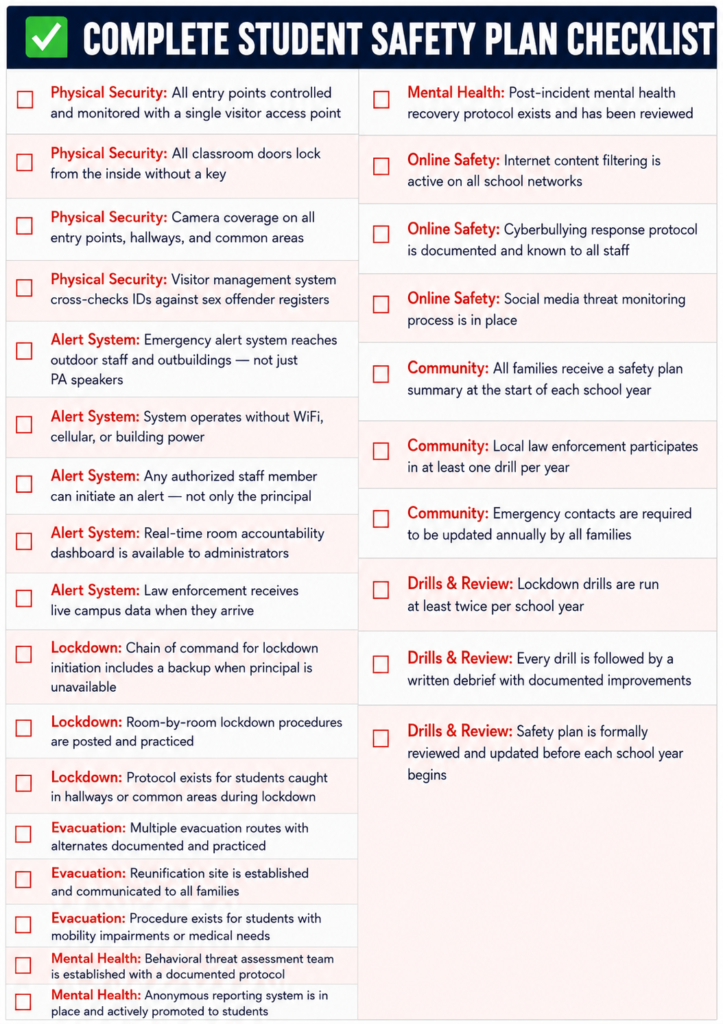
Complete Student Safety Plan Checklist
Use this checklist to evaluate your school’s current safety plan against best-practice standards:
How SimulAlert® Strengthens Every Component of Your Student Safety Plan
SimulAlert was designed specifically to solve the most common and most dangerous weakness in school student safety plans: the gap between a written procedure and a functioning communication system that actually executes it in real time.
The Alert & Communication Problem SimulAlert Solves
Most schools list an emergency alert system in their safety plan — and most of those systems fail at the exact moment they are needed. PA systems may miss outdoor areas. Cell phones congest. Internet-based apps go down when power goes out. The result is a safety plan that works perfectly on paper and falls apart in a real emergency.
SimulAlert’s operates completely independently of school Wi-Fi. When an emergency begins, the system works — period.
What SimulAlert Delivers for Your Student Safety Plan:
- Instant campus-wide alerts via wearable staff badges: Any authorized staff member initiates a full campus alert with a single button press from anywhere on the property — outdoors, in the gym, in a portable classroom. No phone, no Wi-Fi, no delay.
- Real-time room accountability dashboard: Administrators see live confirmation of which rooms are locked down and accounted for within seconds of an alert — turning a historically chaotic process into a clear, actionable display.
- Law enforcement integration: First responders receive live building status information the moment they arrive, dramatically reducing the time before they can act with accurate situational awareness.
- Multiple alert types: SimulAlert’s color-coded badge system allows staff to signal different emergencies — lockdown, medical emergency, administrative assist — without ambiguity or false alarms.
- Alyssa’s Law compliance: SimulAlert’s system meets the silent panic alarm requirements of Alyssa’s Law, which is now enacted or pending in a growing number of states.
🔗 Related Reading → Alyssa’s Law & School Safety: What Districts Must Know |
5 Common Mistakes Schools Make With Student Safety Plans
- Writing a plan no one practices. A safety plan that has never been tested is not a safety plan. Conduct at least one tabletop exercise per year and a minimum of two live drills.
- Letting the plan go stale. Last year’s plan with last year’s staff contacts, last year’s room assignments, and last year’s law enforcement protocols is a liability. Build an annual mandatory review into the calendar with a dedicated meeting.
- Assuming the principal is always available. Every procedure that says ‘the principal initiates…’ needs a backup chain of command. Document it. Test it.
- Treating the PA system as an emergency communication system. PA systems cover classrooms. They may not cover parking lots, athletic fields, portables, or bathrooms. If staff outside can’t hear the alert, they are unprotected. Your communication system must reach everyone.
- Leaving families uninformed until after an emergency. Parents who don’t know your reunification plan will converge on the school during an active emergency. Brief them every year — before anything happens.
Conclusion: A Safety Plan That Actually Works When It Has To
A safety plan for students is only as strong as the systems, training, and technology behind it. Documents do not save lives. Prepared staff with reliable tools and clear procedures do.
If your safety plan checks every box on paper but your emergency alert system cannot reach outdoor staff, or your lockdown initiation depends entirely on one person being reachable, or your accountability protocol requires calling every classroom individually — those are gaps that a real emergency will find.
The checklist in this guide gives you a clear picture of where you stand. The next step is addressing what is missing — starting with the communication system that everything else depends on.
🚀 Ready to Strengthen Your Student Safety Plan? → Request a Free SimulAlert Demo → Get the Tabletop Exercise Guide → Take the Quick Evaluation Checklist |